


• About Us
    • How to Apply for Research Studies
    • Application for measurement for external users
    • Regulations
      • Consent to the processing of personal data
  • Research Park
    • Resource Centres
    • Equipment
    • Methods
    • Service list
  • News
  • Work of Research Park
    • Reviews
    • Publication
    • Statistics
  • Promotional materials
    • Our partners
    • Presentations
    • Booklet Research Park
  • Contacts

17.03.2014 Open Day on April 2

Details
Hits: 1548

On Wednesday, April 2, 2014 during the conference “Mendeleev-2014″ there will take place an open day in our Center. A tour around the Center is scheduled to start at 15:00 to 16:30 for all interested conference participants.

logo_md2

13.03.2014 Tetrahedron Letters 2014

Details
Hits: 1549

Alena S. Pankova, Mikhail A. Kuznetsov

«Synthesis and thermal transformations of spiro-fused N-phthalimidoaziridines»

Tetrahedron Letters, 2014, In Press

DOI: 10.1016/j.tetlet.2014.03.014


Oxidation of N-aminophthalimide in the presence of 2-arylideneinden-1,3-diones with electron-withdrawing substituents gives the corresponding 3-aryl-1-phthalimidospiro[aziridine-2,2’-indene]-1’,3’-diones in good yields. Heating these aziridines with standard dipolarophiles (N-phenylmaleimide, dimethyl acetylenedicarboxylate, maleate and fumarate) leads, in most cases, to spiro[inden-2,2’-pyrrole] derivatives as products of 1,3-dipolar cycloaddition of the intermediate azomethine ylides with up to 70-95% yields in the case of N-phenylmaleimide. As is typical for 2-acylaziridines, the competing rearrangement into 2-aryl-4H-indeno[2,1-d][1,3]oxazol-4-ones prevails for less active dipolarophiles. Increasing the electron-releasing properties of the 3-aryl ring allows the observation of the push-pull effect of electron-donating and electron-withdrawing substituents on the ease of the three-membered ring-opening.

12.03.2014 Visiting rectors

Details
Hits: 1320

Representatives of the Council of Rectors of the North-West Region have visited our Center with an introductory tour. The guests got acquainted with the equipment and learned the principles of Center’s work.
News on the site of the University.

07.03.2014 Dalton Transactions

Details
Hits: 1498

Julia R. Shakirova, Elena V. Grachova, Antti J. Karttunen, Vladislav V. Gurzhiy, Sergey P. Tunik and Igor O. Koshevoy

«Metallophilicity-assisted assembly of phosphine-based cage molecules»

Dalton Trans., 2014, Advance Article

DOI: 10.1039/c3dt53645a


A family of supramolecular cage molecules has been obtained via self-assembly of the phosphine–gold coordination complexes following an aurophilicity-driven aggregation approach. Use of the di- (PP) or tridentate (PPP) phosphine ligands Pn (n = 2, 3) with rigid polyaromatic backbones leads to clean formation of the coordination Pn(Au(tht))nn+ species, sequential treatment of which with H2O/NEt3 and excess of H2NBut gives the finite 3D structures of two major types. The cylindrical-like hexametallic cages [(PPAu2)3(μ3-NBut)2]2+ are based on the diphosphines PP = 1,4-bis(diphenylphosphino)benzene (1), 4,4′-bis(diphenylphosphino)biphenyl (2), 4,4′′-bis(diphenylphosphino)terphenyl (3), while the triphosphine PPP (1,3,5-tris(diphenylphosphinophenyl)benzene) produces a tetrahedral dodecagold complex [(PPPAu3)4(μ3-NBut)4]4+ (4). The cages 1–4 have been studied using the ESI-MS and 1H, 31P NMR spectroscopy, and the crystal structures of 1 and 4 were determined by an X-ray diffraction study. The NMR spectroscopic investigations showed that cylindrical complexes 1–3 undergo twisting-like interconversion of the helical P↔M isomers in solution, while 4 is a stereochemically rigid compound retaining its axially chiral architecture. The difference in dynamic behaviour was rationalized using computational studies with density functional methods.
07.03.2014 Chemistry of Heterocyclic Compounds

Details
Hits: 1519

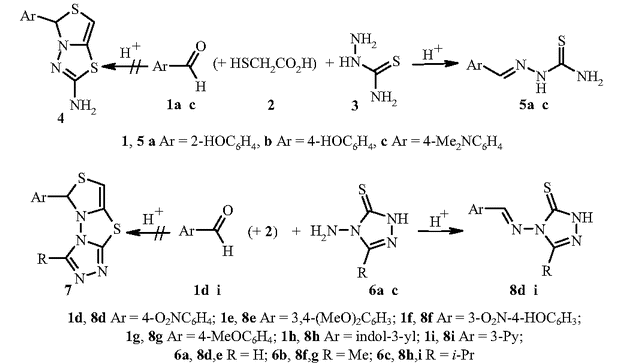
M. A. Kuznetsov, A. Ya. Bespalov

«One-pot, Three-component Synthesis of [1,3]thiazolo[4,3-b][1,3,4]thiadiazoles: Correct Structure of the Products»

Chem. Heterocycl. Compd., 2014, 49, 1458-1463

DOI: 10.1007/s10593-014-1396-4


The products of the one-pot, three-component synthesis of [1,3]thiazolo-[4,3-b][1, 3, 4]thiadiazoles from aromatic aldehydes, thioglycolic acid, and compounds containing a C(=S)–N–NH2 fragment (thiosemicarbazide or 4-amino-2,4-dihydro-3H-1,2,4-triazole-3-thiones) are not condensed hetero-cycles (as reported by several researchers), but are thiosemicarbazones or triazolylimines of the aldehydes used.

  1. 06.03.2014 Announcing seminars on March 13th and 20th, 2014
  2. 20.01.2014 Article accepted for publication in Dalton Trans.
  3. 09.12.2013 Gurinov Andrey has received a certificate
  4. 06.12.2013 International Committee on Science Policy
  5. 05.12.2013 Transatlantic seminar 04.12.2013

Page 5 of 16

  • 1
  • 2
  • 3
  • 4
  • 5
  • 6
  • 7
  • 8
  • 9
  • 10

Select your language

  • Russian
  • English (UK)
  • About Centre MRR
  • Equipment RC MRR
  • Methods RC MRR
  • Staff RC MRR
  • News RC MRR
  • Contacts RC MRR
  • Website RC MRR
© 2025 Research Park, St Petersburg University
Support: esrc-support@spbu.ru