
- Details
- Category: Light microscopy
- Hits: 2595
The Leica TCS SP5 is a laser-confocal microscope designed on the basis on the inverted mictoscope Leica DMI6000 for the visualization of the spatial structure of the living as well as fixed tissue samples up to 200 µm in depth. However, for the tissue samples with depth above 80-100 µm, two-photon microscopy is recommended to be used. The Leica TCS SP5 provides the full range of scan speeds and the highest resolution. The instrument allows to make optical tissue sample sections both in the plane and in depth, thus making it possible to create 3D reconstruction of the specimen. For more information visit www.leica-microsystems.com.

- Details
- Category: Light microscopy
- Hits: 2455
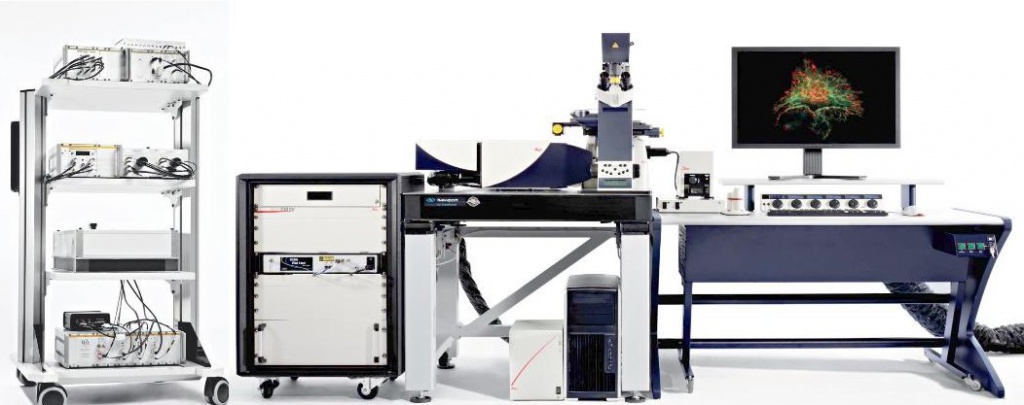
The Leica TCS SP5 MP comprises confocal microscope and multiphoton system and is designed for deep imaging and spesial imaging methods. The microscope is equipped with two-photon and "white" lasers covering almost all confocal and multiphoton applications. For more information visit www.leica-microsystems.com.
- Details
- Category: Light microscopy
- Hits: 2677
The Leica STED-CW is the complementary device to the confocal microscope providing nanoscopic research level. The device allows to study living cells with the dot pattern of 512 x 512 dots, with the up to 18 frames/sec speed and with the resolution up to 80 nm; to study living cells a number of fluorescen proteins could be used, such as Citrine, YFP, etc.; to study fixed material with the resolution up to 80 nm conventional fluorescent dyes such as Alexa 488, FITC and Oregon Green could be used; to use singe molecule detection technique for the reduction of the excitation spot in the lateral plane up to 80 nm. For more information visit www.leica-microsystems.com.

- Details
- Category: Light microscopy
- Hits: 2891
Leica WLL is the complementary system to the confocal microscope allowing fine tuning of fluorochrome excitation wavelengths resulting in the minimum cross-excitation and specimen damage. The system provides spectral specimen scanning with the excitation wavelength acquiring; phototoxicity reduce; fluorescence attenuation imaging (FLIM) with the excitation within 470-670 nm; precise spectral discrimination of fluorochromes with nearby emission spectra; etc. For more information visit www.leica-microsystems.com.

- Details
- Category: Light microscopy
- Hits: 2630
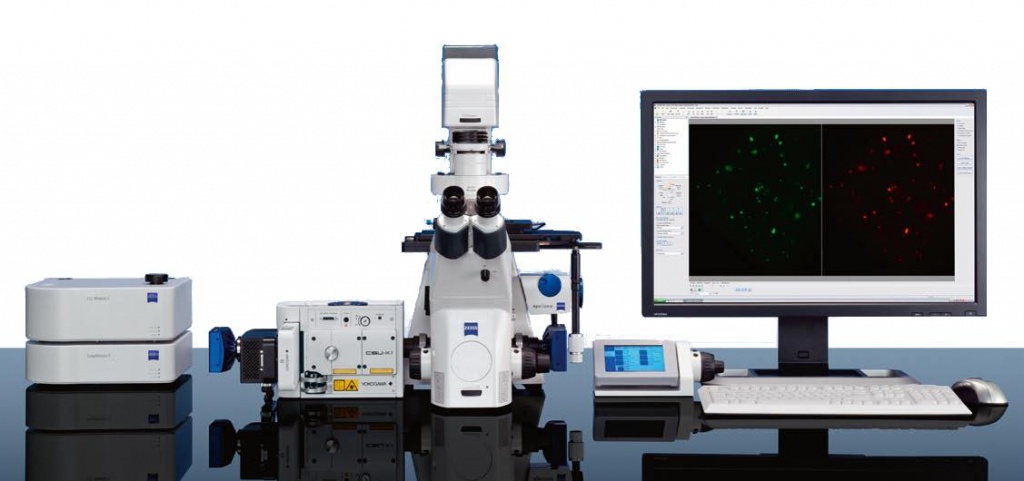
The Cell Observer Spinning Disk (Nipkow Disk) confocal microscope is designed to study quickly proceeding processes inside the living cell. In contrast to the scanning laser confocal microscopy, spinning disk confocal microscopy allows to reach high speed scanning with decent contrast and minimized phototoxicity. The instrument provides all types of applications requiring sensitivity and speed in the trade-off the resolution, such as high-speed imaging of the dynamic processes in cells, time-lapse imaging with low phototoxicity, etc. For more information visit microscopy.zeiss.com.