


11 июня — укороченный рабочий день
12-15 июня — выходные дни
M. Popova, D. Michel
«Behavior of Sodium Lauroyl Sarcosinate in Solution and Binary Mixtures by Means NMR»
Applied Magnetic Resonance 2014, 45, 353-364
DOI 10.1007/s00723-014-0531-9

Measurements of the 1H and 13C chemical shifts as well as 1H spin–lattice relaxation times of sodium lauroyl sarcosinate (SLAS) in aqueous solutions and mixed binary systems with co-surfactants were carried out at various concentrations. It will be shown that changes in the chemical shifts for the N–CH2 groups in SLAS with increasing surfactant concentration can be used to estimate the ratio pcis /ptrans of cis- and trans-isomers. The relative fraction p trans of molecules in trans-configurations increases the most in a narrow concentration range 0.007–0.034 mol/l, i.e., at the transition from the monomeric state to the micelle. The ratio pcis /ptrans asymptotically decreases with increasing concentration, reaching a constant value at concentrations significantly above the critical micelle concentration. Thus, the ratio can be related to the process of micellization. If micellization takes place, the cis-isomer starts to transform into trans-isomer because the trans-isomer is more favorable in micelles. Because of the smaller cross section of the polar group region, the trans-conformation can be more easily incorporated into the micelle. In summary, the occurrence of micellar aggregates at low SLAS concentration in mixed systems can be clearly inferred from the nuclear magnetic resonance spectra.
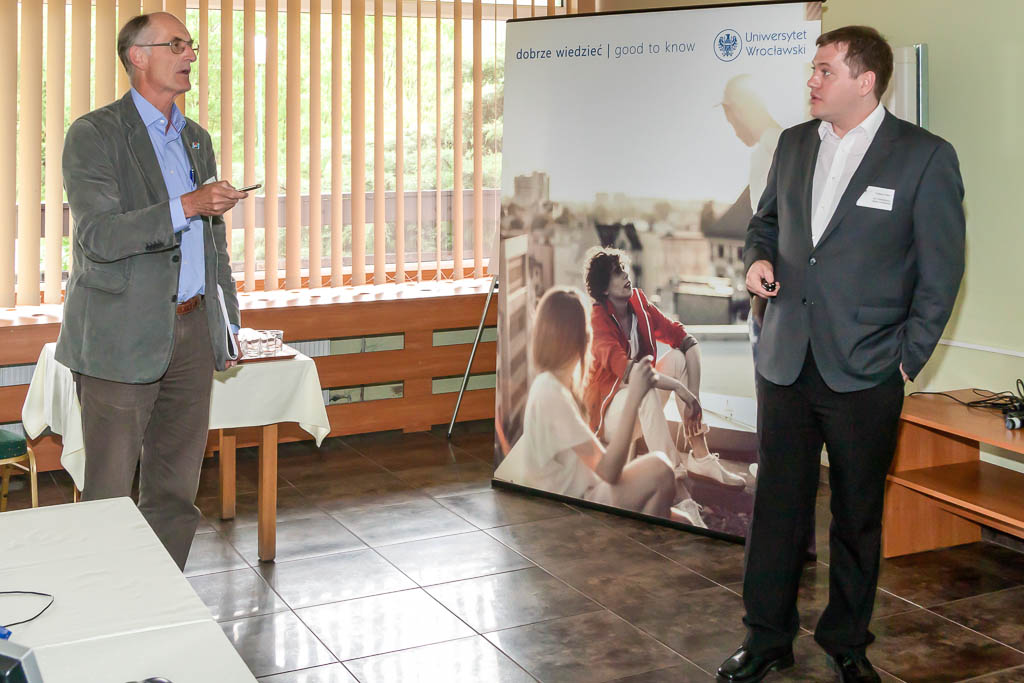
Сотрудники РЦ приняли участие в конференции Central European School on Physical Organic Chemistry, прошедшей в г. Пшесека (Польша) 26-30.05.2014.
Был представлен пленарный доклад
P.M. Tolstoy, S.A. Pylaeva, B. Koeppe, E.Yu. Tupikina, C. Allolio, D. Sebastiani, G.S. Denisov, H.-H. Limbach
«Aprotic Polar Solvent Dynamics and Proton Tautomerism in Strong Hydrogen Bonds. NMR, UV-vis and MD Study»

и постерная презентация
M.A. Vovk, A. Kwocz, T. Kozlecki, P. Tretyakov, P.M. Tolstoy, A. Filarowski
«NMR study of hindered internal rotation in β-hydroxynaphthylamides».
В мае выполнено 1230 заявок на сервисные измерения.
Измерено:
- 1190 спектров 1H
- 311 спектров 13C
- 141 спектр DEPT
- 64 спектра COSY
- 46 спектров NOESY
- 52 спектра 31Р
- 35 спектров 19F
Выполнено 59 заявок на выполнение работ, измерения по которым в сумме заняли 704 часа.

